ChatGPT Reaches 900 Million Weekly Users — but One in Five Is Also Using a Competitor, A16z Finds
A16z's latest Top 100 AI ranking shows ChatGPT still dominates but users freely switch between models — suggesting the AI market is splitting into platforms rather than consolidating around a single winner.

ChatGPT’s weekly active user count grew from 400 million to 900 million over the past year, meaning more than one in ten people on Earth now uses it every week. Yet the sixth edition of Andreessen Horowitz’s Top 100 Generative AI consumer apps — drawing on SimilarWeb and Sensor Tower data from January 2026 — reveals something investors backing billion-dollar AI valuations would rather not dwell on: nobody is loyal to their chatbot.
About 20% of weekly ChatGPT web users also use Gemini in any given week. Claude’s paying U.S. subscribers grew more than 200% year over year; Gemini’s grew 258%. On the web, ChatGPT still pulls 2.7 times Gemini’s traffic, but the direction of travel matter
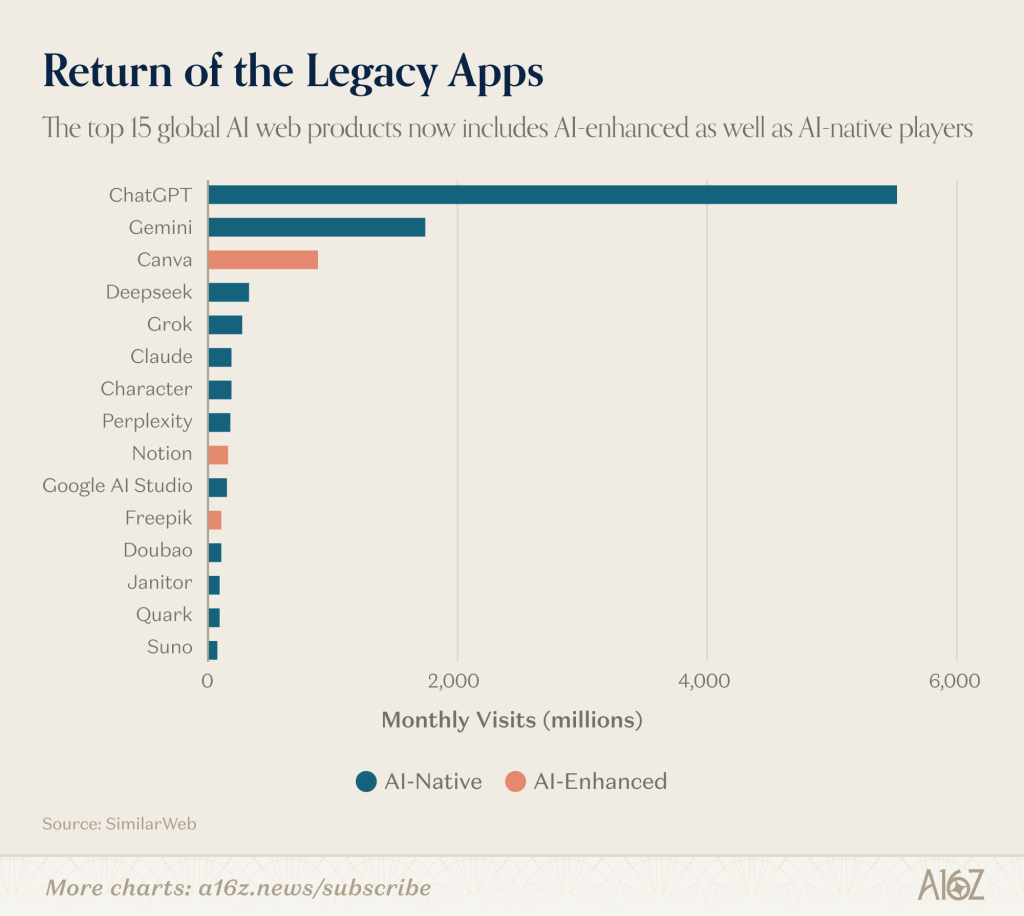
The AI assistant market, a16z concludes, is starting to look less like the search engine wars, where Google captured and held 90% of query volume, and more like the smartphone platform wars, where two ecosystems with different philosophies each built massive but non-overlapping user bases. The analogy isn’t perfect, but the implication is clear: the winner-takes-all outcome that justified much of the early AI investment thesis is not the one currently materializing.
ChatGPT Wants to Be a Super-App While Claude Is Betting on Developers
ChatGPT and Claude are already diverging into different strategic territories. ChatGPT now offers more than 85 app integrations across travel, shopping, food, and health categories — what a16z calls “the most aggressive play any AI company has made to become a consumer super-app.” Claude’s integrations, by contrast, concentrate in developer tools, financial data providers, and scientific databases.
The report suggests both strategies can sustain large ecosystems, but they are competing for different users in different contexts rather than converging on the same audience.
The geographic picture is just as fractured. The market has split into three distinct blocks. Western tools share overlapping user bases drawn from the U.S., India, Brazil, the UK, and Indonesia. Chinese domestic products — ByteDance’s Doubao and Moonshot’s Kimi — dominate in China.
Russia has become a third pole: Yandex’s AI assistant Alice reached 71 million monthly active users, a gap that a16z attributes directly to sanctions forcing users onto local alternatives. DeepSeek is the only product that bridges all three blocks. On a per-capita basis, Singapore ranks first in AI adoption; the U.S. comes in 20th.
Midjourney Fell From Top 10 to 43rd. Agents Are Next!
The standalone creative tools category has largely collapsed. Midjourney, which was a top-10 product a year ago, has fallen to 43rd place after ChatGPT and Gemini built capable image generation directly into their chat interfaces.
The lesson is not lost on the agents category, which is still forming: OpenClaw reached 68,000 GitHub stars within weeks of going viral, and Chinese AI startup Manus was acquired by Meta for an estimated $2 billion shortly after launch. Agents that remain standalone platforms face the same risk Midjourney ran — that the large general-purpose chatbots will absorb the functionality before the standalone product can build defensible scale.
The a16z report acknowledges its own methodology is getting harder to apply as AI shifts from products users visit deliberately to features embedded invisibly across apps they already use.


