
- The 90-day correlation between Bitcoin and the DXY hit 0.60, meaning both assets are now moving in tandem rather than opposite directions.
- Bank of America’s February survey of 42 funds managing $702B shows the most negative dollar positioning in the series’ entire history.
- Record short dollar positioning raises short squeeze risks that could push Bitcoin higher or lower depending on which market dynamic prevails.
This Tuesday, Bank of America released the results of its monthly fund manager survey, and the figure that commanded the market’s attention was striking: institutional investors are betting against the U.S. dollar with a conviction not seen since January 2012.
The survey, conducted between February 6 and 11 with 42 funds collectively managing approximately $702 billion, showed that net positioning in the greenback fell to its most negative—or bearish—level in the entire history of the series.
What stands out is not just the magnitude of the bet, but the timing. Bitcoin, which has historically benefited when the dollar weakens, was trading around $68,150 on Tuesday with a 1% decline on the day, according to CoinDesk.
The Dollar at Its Most Bearish Level Since 2012—But Bitcoin Isn’t Reacting Like It Used To
According to CoinDesk, survey respondents anticipate further weakening of the U.S. economy and see a growing probability that the Federal Reserve will cut interest rates. The labor market is the primary catalyst cited: if employment deteriorates, rate cuts come back into the conversation and the dollar loses ground.
Bank of America also noted that most investors prefer to increase their currency hedges or simply reduce exposure to U.S. assets.
There is a caveat the bank flagged in its own report: some responses came in before the latest U.S. jobs report was released—a report that came in stronger than expected. That means real positioning could be somewhat less extreme than the data suggests, though it remains historically pronounced.
The Dollar Index (DXY) shed more than 9% over the course of 2025 and continues to slide into 2026, which under normal circumstances would have served as a tailwind for risk assets like Bitcoin.
But 2025 changed that equation. Since the beginning of that year, Bitcoin began moving in tandem with the dollar rather than in the opposite direction—an anomaly analysts are still trying to process. The DXY fell, BTC fell too: both ended 2025 in the red.
The 90-day correlation between Bitcoin and the DXY reached 0.60 on Monday, its highest reading since April of last year, according to CoinDesk. In simple terms, the two assets are behaving like partners, not rivals.
A Dollar Short Squeeze: The Wild Card That Could Reshape the BTC Picture
The massive bearish dollar positioning revealed by BofA creates the conditions for what financial markets call a short squeeze—a sudden, forced wave of buying that occurs when those who bet on the downside are compelled to close positions all at once to limit losses, pushing the asset’s price sharply higher.
Eamonn Sheridan, chief Asia-Pacific currency analyst at InvestingLive, framed it this way on Tuesday: “Record short positioning raises the risk of volatility in major USD pairs; downside may extend on weak US data, but crowded trade dynamics increase potential for sharp short-covering rallies.”
If the positive correlation between BTC and the DXY holds, a forced dollar rebound could drag Bitcoin higher along with it, flipping traditional logic on its head. But if the historical inverse relationship reasserts itself—as it did for most of crypto’s history—that same dollar rebound would weigh on BTC.
Either scenario points to the same conclusion: more volatility, not a clean signal in any single direction.
What is clear is that Bitcoin has now posted five consecutive months of losses, something unprecedented in its 17-year history, and that spot BTC ETFs recorded net outflows exceeding $6 billion between November 2025 and February 2026.
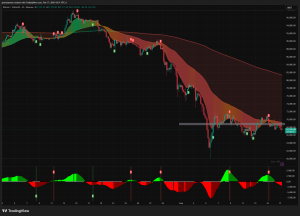
In that context, the BofA survey does not resolve the central question: whether the dollar’s next meaningful move ultimately acts as a bullish or bearish signal for Bitcoin depends entirely on which version of the asset—the independent store of value or the correlated risk asset—decides to show up first.
At the time of writing, Bitcoin is trading at $68,150 after a 1% decline over the past 24 hours, with a market capitalization of approximately $1.38 trillion.


